
Why Main Street Is Consolidating: The Case for Regional Consumer M&A
EXECUTIVE SUMMARY
A quiet consolidation is reshaping the lower middle‑market consumer economy. Regional grocers, restaurant groups, specialty retailers, food and agriculture businesses, packaging companies, and e‑commerce operators have long been defined by local ownership, customer loyalty, and community identity. Increasingly, those same businesses are becoming attractive acquisition targets for strategic buyers, private equity firms, family offices, and other long duration investors seeking durable brands and established local market positions.
The forces behind this shift are structural rather than purely cyclical. Family business succession is approaching a decision point at the same time that the cost of competing has risen across labor, logistics, technology, insurance, compliance, and customer acquisition. Deloitte Private found that 78% of surveyed family‑business executives expect a CEO transition within the next decade, yet only 23% are actively implementing a succession plan. In grocery, PwC identified 119 domestic transactions from 2020 through 2025, with approximately 95% led by strategic buyers and roughly 19,100 owners age 55 or older.
Buyer interest does not translate into uniform valuations. PwC’s 2026 midyear outlook identifies premiums for selected consumer assets, while noting financing challenges for leveraged transactions in the $100 million to $1 billion range. For regional sellers, sustainable earnings, strategic fit, and the buyer’s ability to finance and close a transaction matter more than headline deal values.
This does not mean every local consumer business will become an M&A target. The 2026 consumer deal market is increasingly selective, with capital concentrating around businesses that offer resilient demand, category leadership, strong customer access, valuable locations, or supply chain control. The opportunity is less about indiscriminate roll‑ups and more about combining local relevance with institutional scale. For owners, that creates more strategic alternatives. For buyers, it creates a path to growth that can be faster and more defensible than building from scratch.
WHY MAIN STREET IS CONSOLIDATING
Headline consumer M&A is often dominated by megadeals, but the logic driving lower middle‑market consolidation is different. Regional and family‑owned businesses frequently possess assets that are difficult to recreate organically: long standing customer relationships, strong local brands, scarce real estate, supplier networks, experienced employees, and trusted community reputations. At the same time, the infrastructure required to compete, from digital loyalty and data analytics to procurement systems and e‑commerce fulfillment, increasingly rewards scale.
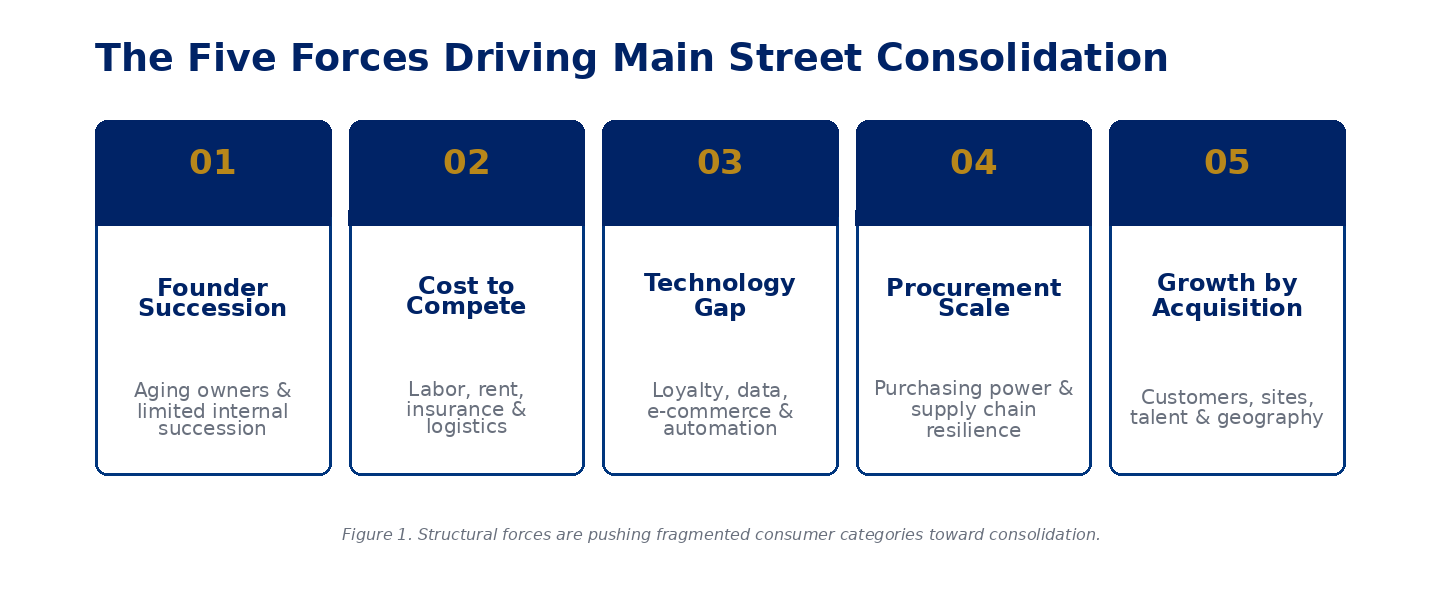
Five forces are converging across fragmented consumer categories:
Founder succession and generational transitions are expanding the pool of potential sellers
Rising labor, rent, insurance, logistics, and compliance costs are increasing the value of scale
Technology investments in loyalty, data, e‑commerce, automation, and cybersecurity favor larger platforms
Procurement leverage and supply‑chain infrastructure can improve resilience and unit economics
Acquisitions can deliver customers, locations, talent, and geography faster than organic expansion
SUCCESSION IS EXPANDING THE SELLER POOL
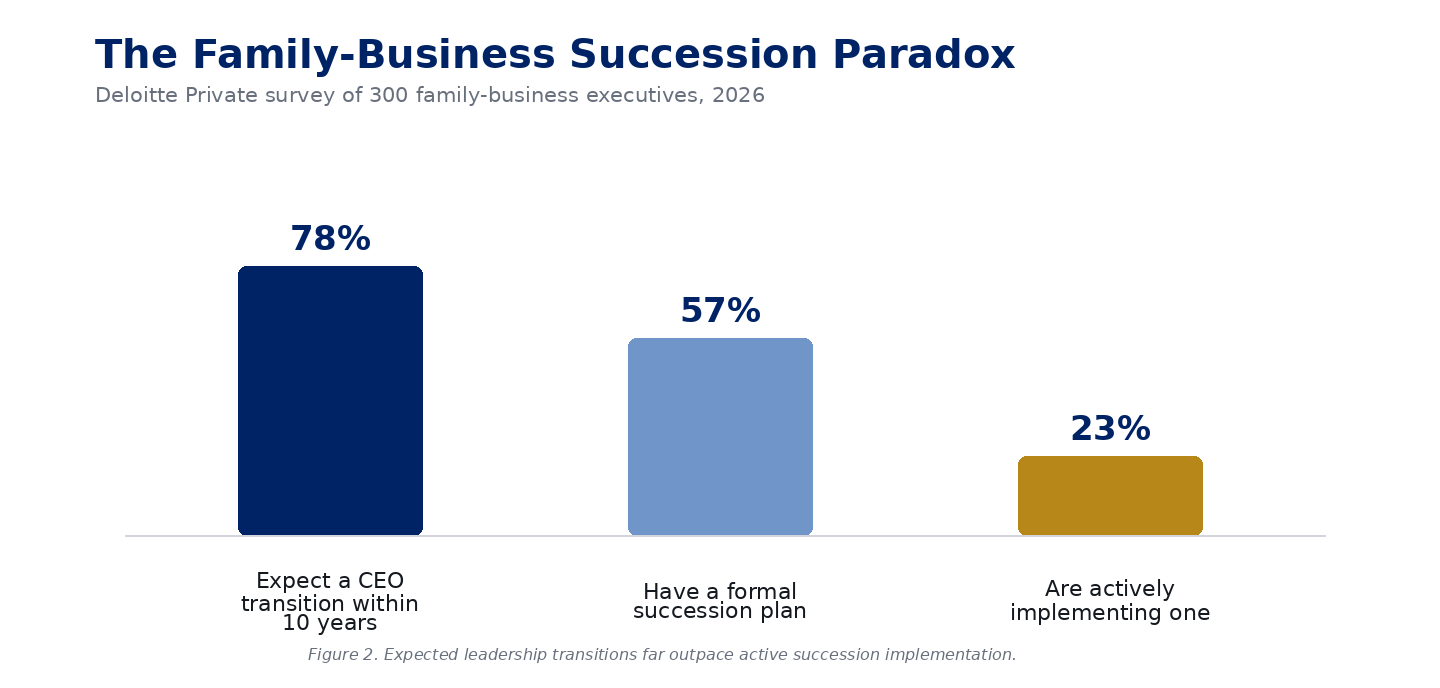
Deloitte Private's 2026 survey of 300 family business executives found that 78% expect a CEO transition within ten years and 42% expect one within three to five years. Yet only 57% have established a succession plan, 23% are actively implementing one, and 30% say their planning is behind schedule. The gap between expected transitions and active preparation is significant.
A leadership transition does not automatically imply a sale. Families can pass ownership to the next generation, recruit outside management, recapitalize, or bring in a minority partner. But the transition forces a broader question: whether the business is best positioned to remain independent, or whether a strategic combination could provide liquidity, continuity, and resources for the next phase of growth.
That question is especially important in consumer businesses, where enterprise value is often inseparable from legacy. A regional banner, neighborhood reputation, supplier relationships, and employee culture may have been built over decades.
For many owners, a buyer's willingness to preserve that identity can matter alongside valuation. The highest price is not always the only consideration when employees, customers, and a family name are part of the transaction.
This helps explain why regional strategic acquirers are frequently well positioned in succession driven deals: they understand the same operating model and can create back‑office scale while preserving local customer relationships.
SCALE IS BECOMING A COMPETITIVE REQUIREMENT
Consumer businesses operate in categories where margins can be narrow and operating complexity is high. Wage pressure, rent, insurance, transportation, input costs, regulation, and promotional intensity create fixed or semi‑fixed costs that are easier to absorb across a larger revenue base. Scale can also provide more flexibility to invest through periods when consumers are trading down or shifting spending across channels.
Technology is widening that gap. Loyalty programs, digital ordering, customer relationship management, demand forecasting, electronic shelf labels, automated replenishment, cybersecurity, and AI‑enabled analytics increasingly shape how consumer companies compete. A regional platform can spread those investments across dozens or hundreds of locations, while a single‑location or small‑chain operator may struggle to justify the same spend.
Procurement and supply‑chain infrastructure create a second source of advantage. Larger buyers can consolidate indirect spend, negotiate across a broader purchasing base, standardize vendor contracts, and invest in distribution capabilities that smaller operators cannot easily replicate. In grocery, food distribution, restaurants, and packaging, those benefits can improve both margins and resilience.
The result is a stronger build versus buy case. PwC notes that a new grocery store can require two to three years to reach steady‑state profitability, while an acquired store can bring employees, supplier relationships, infrastructure, and cash flow on day one. The exact economics differ by sector, but the principle travels well: when locations, customers, and local know‑how matter, buying an established operator can be faster and less risky than creating one from the ground up.
WHAT BUYERS ARE ACQUIRING
The most attractive regional targets are not valuable simply because they are small or family‑owned. They are valuable because they possess local assets that are difficult to manufacture: customer trust, repeat traffic, favorable sites, category expertise, durable supplier relationships, experienced managers, and a brand that means something in its market.
That distinction matters in a selective deal environment. PwC's 2026 consumer‑market outlook describes capital as concentrating around 'must‑have' assets with resilient demand, category leadership, stronger customer access, or greater supply‑chain control. Consumer deal value has remained active even as transaction volume has been more subdued, reinforcing that buyers are willing to pay for strategic fit but are less willing to underwrite undifferentiated growth.
For family‑owned companies, local identity can be an asset rather than a constraint when it is supported by sound operations, stable margins, repeatable unit economics, and management that can operate beyond the founder.
For acquirers, the value‑creation playbook is often to centralize what customers do not see ‑ finance, IT, purchasing, compliance, data, and shared services ‑ while preserving the merchandising, service, community ties, and brand characteristics that customers do see.
How Buyers Translate Interest into Value
Interest rates affect acquisition economics through the cost of debt and the cash flow available to service it. Higher borrowing costs can reduce debt capacity or require more buyer equity, putting pressure on the price a financial sponsor can justify. A strategic buyer with available cash and credible operating synergies may assess the same business differently. A lower policy rate alone does not ensure easier financing; lender terms and business risk also matter.
Owners should evaluate valuation against comparable businesses of similar size, category, growth, and profitability. A defensible earnings base, stable margins, transferable relationships, and management continuity can support stronger pricing. Founder dependence, concentration, deferred investment, or volatile cash generation can reduce the multiple or shift consideration into contingent payments. Large public‑company transactions are not direct benchmarks for a smaller private business.
An illustrative example shows why preparation matters: at an assumed 6.0x EBITDA multiple, a $500,000 reduction in accepted annual earnings reduces enterprise value by $3 million. This is arithmetic, not a market valuation benchmark. Owners must then bridge enterprise value to equity proceeds for debt, cash, and agreed working‑capital adjustments, and assess fees, taxes, escrows, and any deferred consideration to understand what they actually receive.
GROCERY IS THE CLEAREST PREVIEW
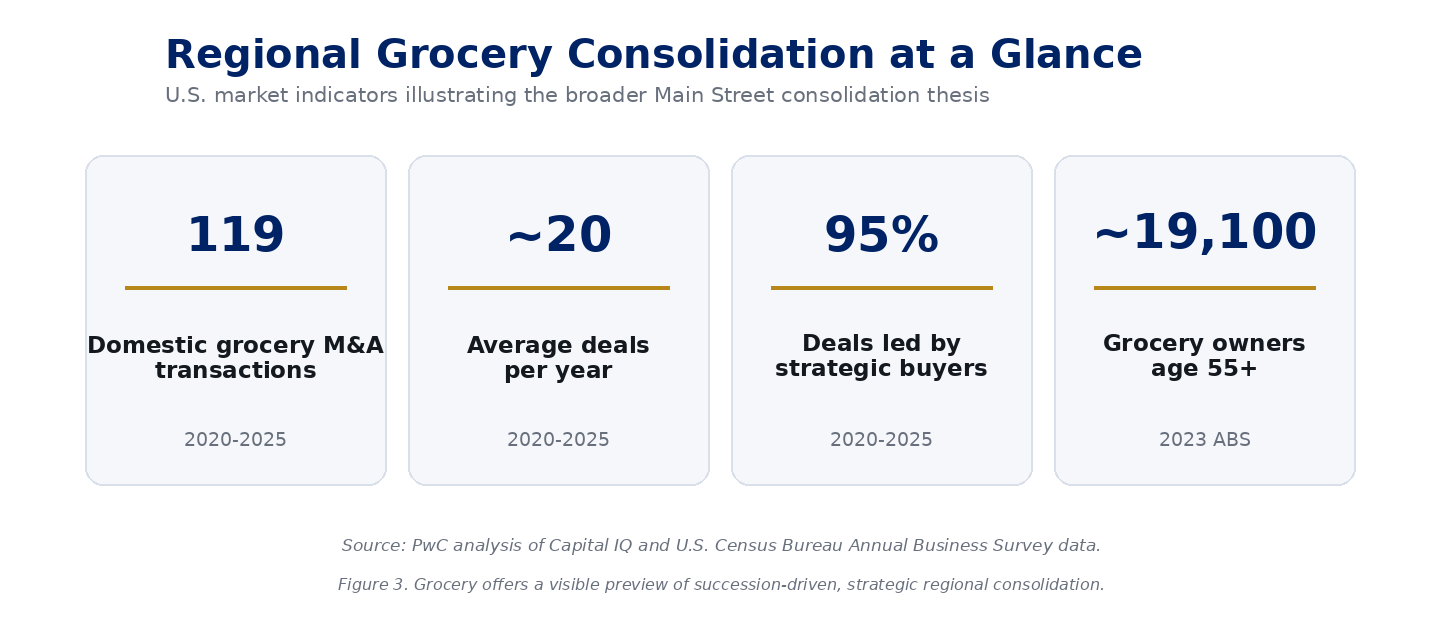
Grocery offers one of the clearest examples of the broader Main Street consolidation pattern. The sector combines essential demand with local merchandising, real‑estate density, complex supply chains, and a large base of family and regional ownership. PwC estimates that national retailers now control more than half of the U.S. grocery market, while four large players account for nearly 70% of grocery e‑commerce sales.
The buyer mix is revealing. PwC identified 119 domestic grocery transactions from 2020 through 2025, or roughly 20 per year, and approximately 95% were led by corporate or strategic acquirers. Fewer than 6% involved a truly national buyer. Much of the consolidation is operators buying operators ‑ regional chains acquiring neighbors and independents to deepen density and spread infrastructure across a larger base.
Recent transactions illustrate the strategy. In October 2025, Schnucks' family holding company completed the acquisition of Festival Foods and Hometown Grocers, bringing the combined family of companies to 164 stores while retaining the existing banners. Casey's acquisition of Fikes Wholesale, owner of CEFCO, added 198 convenience stores and significant new territory in Texas and the Southeast at an aggregate purchase price of approximately $1.17 billion.
Grocery is not the entire thesis; it is a visible laboratory for it. When organic expansion is expensive, local assets retain customer value, and scaled operators can extract efficiencies without erasing the customer proposition, acquisition becomes a rational path to growth.
WHERE CONSOLIDATION IS SPREADING NEXT
Food and agriculture. Branded food, specialty ingredients, distribution, and value‑added manufacturing remain fragmented in many categories. Buyers are increasingly focused on businesses with differentiated products, health and wellness exposure, private‑label capabilities, or manufacturing assets that provide control over quality and supply. PwC reported that U.S. CPG deal value more than doubled year over year in the first quarter of 2026 even as deal volume continued to decline.
Restaurants. Regional concepts and franchise groups can offer buyers proven unit economics, established sites, repeat customers, and a recognizable brand. At the same time, purchasing, labor scheduling, digital ordering, loyalty, marketing, and back‑office systems all reward platform investment. The most scalable regional concepts can therefore become attractive either as platforms or as add‑ons to a larger restaurant group.
Retail, e‑commerce, and packaging. Consumer M&A is increasingly capability‑led as well as scale‑led. Retailers and brand owners are buying fulfillment, first‑party data, customer‑engagement tools, specialized production, and distribution capabilities that would take years to build internally. KPMG's 2026 consumer and retail analysis similarly points to buyer interest in fulfillment, customer engagement, ingredients, nutrition, and manufacturing capabilities.
STRATEGIC BUYERS AND FINANCIAL SPONSORS ARE PLAYING DIFFERENT GAMES
The same family‑owned business can appeal to multiple buyer types, but the investment thesis is rarely identical. Understanding those differences matters because the best buyer may be the one with the clearest strategic rationale and the greatest ability to fund growth after closing.
Strategic Buyers
Regional and national operators can often underwrite direct cost and revenue synergies. They may value geographic adjacency, procurement leverage, distribution density, customer access, or the ability to fold a proven local brand into an existing platform. Their advantage is operating familiarity and a potentially lower execution burden.
Private Equity
Financial sponsors are more likely to view a strong regional business as a platform or add‑on opportunity. The focus is typically on repeatable unit economics, management depth, organic whitespace, and the ability to accelerate expansion through additional acquisitions. Fragmented categories with clear integration playbooks remain particularly attractive.
Family Offices and Long‑Duration Capital
Family offices and other long‑duration investors can be natural partners where legacy and ownership continuity matter. Their investment horizon may be more flexible than a traditional fund structure, which can appeal to owners seeking partial liquidity, continued involvement, or a slower transition in control.
Cross‑Border and Family‑Owned Acquirers
Consumer assets with strong U.S. brands and distribution can also attract international and family‑owned strategic buyers. In 2026, Reuters highlighted growing acquisition interest from large family‑controlled food groups seeking U.S. snack and packaged‑food exposure. For a regional seller, that expands the buyer universe beyond domestic private equity and public strategics.
What Makes a Main Street Business Attractive
The strongest acquisition candidates combine local differentiation with institutional readiness. Common attributes include a defensible brand, recurring or repeat customer behavior, attractive unit economics, density in a defined geography, low dependence on any single employee or location, a capable management team, scalable systems, and a clear path for a buyer to create value without damaging the customer experience.
HOW OWNERS CAN PREPARE BEFORE A PROCESS BEGINS
For an owner preparing for a full sale, readiness means making the business’s earnings, operations, and ownership transferable and verifiable. The work should begin before buyer outreach, while there is time to correct weaknesses and demonstrate improvement. Seven areas deserve particular attention.
Financial Normalization
Build a consistent earnings history that reconciles the general ledger, financial statements, and tax filings. Explain owner compensation, related‑party rent, nonrecurring expenses, and other proposed EBITDA adjustments with supporting records. Normalization must also capture missing costs, such as the expense of replacing a founder who performs several roles. A sell‑side quality‑of‑earnings review can identify disputed adjustments before buyers do. Analyze seasonal working capital and distinguish maintenance from growth capital expenditure so the earnings story is supported by cash generation.
Management Depth Beyond the Founder
Show that the company can retain customers, manage locations, and make operating decisions after the owner leaves. Clarify responsibilities, develop a credible second layer of leadership, and document key processes and relationships. Identify retention arrangements for essential employees and agree on the founder’s realistic transition role. Buyers will assess whether the management team can deliver the plan independently; an undefined handover can lead to a longer required transition, contingent consideration, or a lower offer.
Customer and Supplier Concentration
Measure revenue and gross profit by major customer, channel, location, and product, and purchases by key supplier. Explain the durability of important relationships, contract terms, renewal history, and alternative supply arrangements. For consumer businesses with many individual shoppers, dependence may sit in one marketplace, distributor, franchise system, or high‑performing site. Address avoidable concentration and prepare evidence of retention and purchasing behavior. Identify contracts that require consent on a sale and plan how to secure it without disrupting the business.
Systems Data and Reporting
Produce timely monthly accounts and consistent operating measures that reconcile to reported results. Buyers should be able to follow sales, gross margins, inventory, labor costs, and cash flow by location or business line, using clearly defined measures. Organize an indexed data room and assign responsibility for keeping information current. Review access controls, cybersecurity, and customer‑data practices with appropriate specialists. The goal is reliable, retrievable evidence; an unfinished systems overhaul launched during diligence can create additional disruption.
Legal and Structural Clean Up
Work with counsel to confirm ownership records, shareholder approvals, entity structure, and the assets included in the sale. Review leases, licenses, permits, intellectual property, employment arrangements, litigation, and material contracts. Identify liens, change‑of‑control provisions, and transfer restrictions early. Where the family separately owns real estate or other assets used by the business, establish which assets will be sold and which will remain under documented commercial arrangements. Unresolved ownership or consent issues can delay closing even after price is agreed.
Tax and Estate Planning
Involve tax and estate advisors before committing to a transaction structure. Compare the potential after‑tax proceeds of an asset sale and an equity sale, considering the company’s actual ownership, tax basis, and jurisdiction. Review trusts, estate objectives, and any proposed ownership changes early enough for advisors to assess their feasibility and consequences. Align family members on distributions, decision rights, and liquidity priorities. The relevant outcome is the owner’s net proceeds and agreed transition, not simply the headline purchase price.
Timing and Leverage
Launch when the business can substantiate its performance and management can support diligence without neglecting operations. Build a credible forecast, explain seasonality, and avoid relying on an unproven earnings peak. Assess debt maturities, liquidity needs, required investment, and personal timing constraints that could force a rushed decision. A coordinated process with several qualified buyers can preserve negotiating leverage. Before granting exclusivity, compare funding certainty, approvals, conditions, and timelines alongside price, and agree clear milestones for progressing toward closing.
WHERE DEALS LOSE VALUE OR FAIL
Earnings surprises and price renegotiation
Unsupported add‑backs, deteriorating trading, or inconsistent records can undermine the price agreed in a letter of intent. Buyers may reduce their offer, require an earn‑out, or walk away. Test the earnings case before launch and provide current monthly results throughout the process. Working‑capital targets and debt‑like items should be addressed early so headline agreement does not conceal a proceeds dispute.
Financing consent and execution risk
An attractive bid may depend on financing, investment‑committee approval, lease assignments, or regulatory clearance. Evaluate how each condition will be satisfied and by when. Where competitors are bidding, counsel should assess competition issues and control access to sensitive information. Unresolved conditions can prolong exclusivity and leave the seller with fewer alternatives if the transaction fails.
Disruption and loss of local value
Confidentiality leaks, employee departures, customer uncertainty, and management distraction can weaken performance before closing. After closing, changes to the brand, product mix, service, or supplier relationships may damage the local advantages that justified the acquisition. Establish a controlled communications plan and discuss employee retention, the founder’s transition, and integration priorities during buyer selection. Translate material commitments into negotiated terms where feasible rather than relying on informal assurances.
CONCLUSION
The consolidation of Main Street is not a story about replacing every local business with a national chain. It is a story about a changing definition of scale. Consumer businesses still win through trust, local relevance, service, and brand identity, but the infrastructure behind those advantages is becoming more expensive and more sophisticated. M&A can combine the customer‑facing strengths of a regional operator with the purchasing power, technology, capital, and systems of a larger platform.
For family and founder‑owned businesses, the opportunity is to prepare while they still control the timetable. A credible sale process connects the company’s local strengths with evidence that its earnings and operations can endure under new ownership. The right buyer must be assessed on value, closing certainty, and its plans for the business and people who built it.
Nemean Capital advises lower‑middle‑market owners through the sale process, from assessing readiness and positioning the business to identifying qualified buyers, managing outreach, negotiating terms, and coordinating diligence through closing. Working alongside the owner’s legal, tax, and accounting advisors, we help translate the company’s strengths into a clear investment case and evaluate offers against the owner’s objectives. For owners considering a sale, the first step is a confidential discussion about readiness, value expectations, and timing.
Sources: PwC; Deloitte Private; U.S. Census Bureau; KPMG; Casey’s General Stores; Festival Foods / 1939 Group; Reuters; BDO